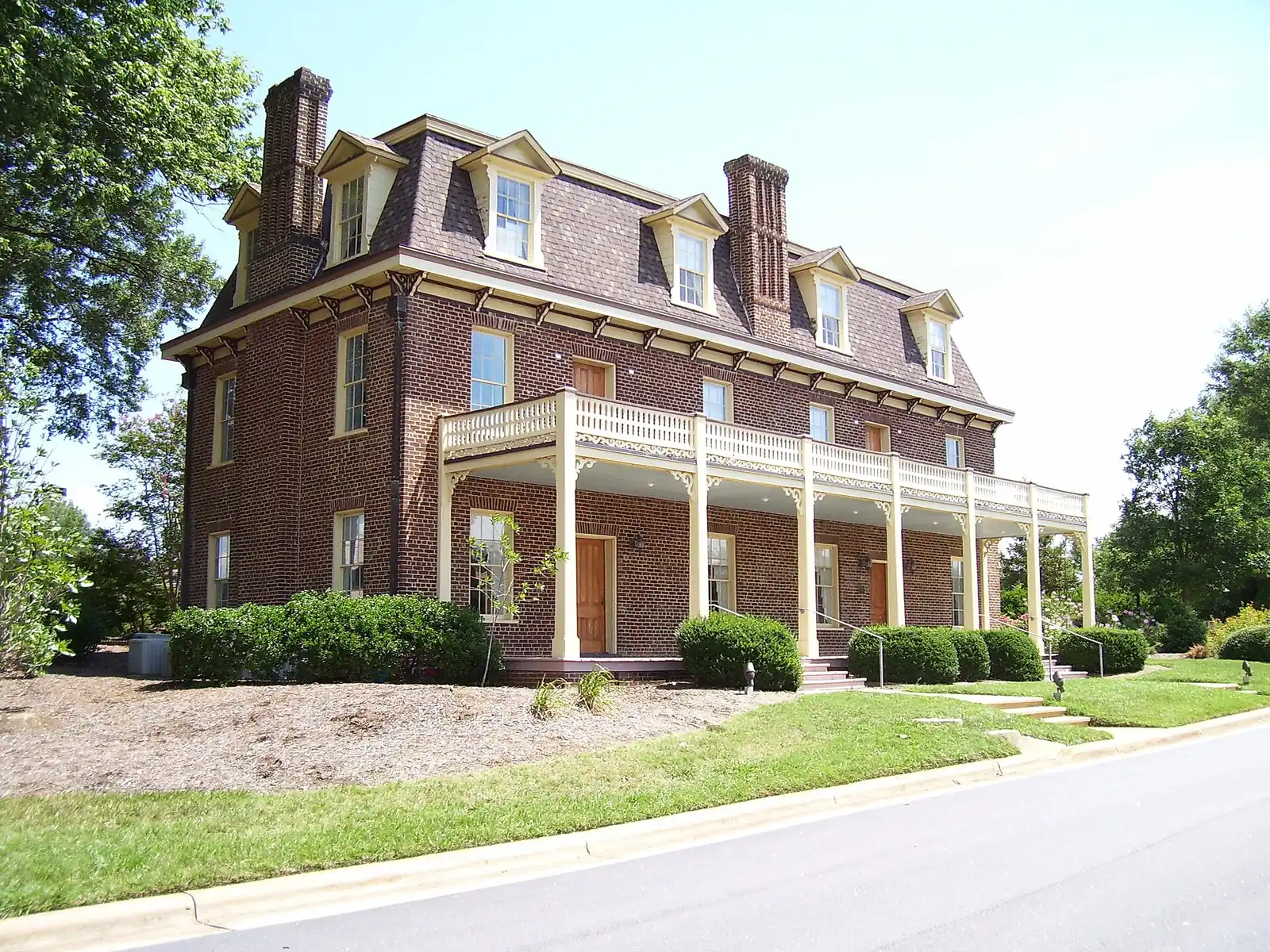
Cary was founded by Frank Page in the 1850s and incorporated in 1871. Its National Register sites include the 1868 Page-Walker Hotel.
Last checked Oct. 11, 2026. Facts on this page come from the Town of Cary’s history page, its historic preservation pages and the National Park Service’s National Register records.
Cary’s roots go back to a 1750s settlement called Bradford’s Ordinary, but the town credits Allison Francis “Frank” Page as its founder, according to its history page. Page and his wife, Catherine “Kate” Raboteau Page, bought 300 acres in 1854. He named the development after Samuel Fenton Cary, a Prohibition leader from Ohio, and served as its first developer, mayor, postmaster and railroad agent. Cary was incorporated in 1871.
Visit
- Page-Walker Arts and History Center and Cary Heritage Museum: 119 Ambassador Loop, 919-460-4963
- Hours: noon to 9 p.m. Monday through Thursday, noon to 5 p.m. Friday, 10 a.m. to 1 p.m. Saturday; closed Sunday and town holidays. Call ahead; rooms are shared.
- Historic preservation questions: Cary 311, or 919-469-4000 from outside town limits
How Cary grew
- 1854: Frank and Kate Page buy 300 acres; Page, whose main business was a sawmill, lays out the first streets and builds a hotel.
- 1871: Cary is incorporated. Several years later the Seaboard and North Carolina railroads form a junction in town.
- 1884: the Pages sell their hotel to the Walker family.
- 1939: a Public Works Administration project builds the Cary High School building on Dry Avenue, successor to the state’s first state-funded public high school.
- 1960s: the development of Research Triangle Park turns a quiet town of a few thousand people into a fast-growing bedroom community.
- 1970s: Cary’s population nearly triples, to 21,763, then doubles in the 1980s and again in the 1990s, the town says.
Frank Page’s son Walter Hines Page (1855-1918) was an editor, publisher and advocate for public education who served as U.S. ambassador to Great Britain during World War I.
National Register of Historic Places
Cary has three individually listed properties and three historic districts on the National Register, according to the town’s National Register page. Listing is an honor; it does not stop owners from changing their property.
| Listing | Location | Listed |
|---|---|---|
| Page-Walker Hotel (built around 1868) | 119 Ambassador Loop | 1979 |
| Nancy Jones House (built around 1803) | Chapel Hill Road | 1984 |
| Carpenter Historic District | Carpenter Upchurch Road and Morrisville Carpenter Road | 2000 |
| Downtown Cary Historic District | South Academy Street, South Harrison Avenue, West Park Street and Dry Avenue | 2001 |
| Green Level Historic District | Green Level Church Road north of Green Level West Road | 2001 |
| Utley-Council House (significant year 1820) | 4009 Optimist Farm Road | 2002 |
Years for the Page-Walker Hotel and the downtown and Green Level districts come from the town; the others come from the National Park Service’s records for the Nancy Jones House, Carpenter Historic District and Utley-Council House. The park service lists the Utley-Council House under an Apex address.
- Downtown Cary Historic District: 18 acres with 30 historic houses and the old Cary High School, built from about 1890 to 1945, recognized for its railroad-village and educational architecture.
- Carpenter Historic District: about 210 acres around the crossroads where Carpenter Upchurch Road meets Morrisville Carpenter Road, with three general stores, 15 houses and farm buildings, significant from the late 1800s through 1933.
- Green Level Historic District: about 75 acres along Green Level Church Road, a turn-of-the-century crossroads community with two stores, a church and two farms.
Local landmarks you can see
The Town Council also designates local historic landmarks. Among them, from the town’s landmark pages:
- Page-Walker Hotel, 119 Ambassador Loop: built around 1868 for railroad passengers, a rare Second Empire building in small-town North Carolina, bought by the town in the 1980s and restored in the 1990s. Designated 1994.
- Cary Arts Center, 101 Dry Ave.: the 1939 Cary High School building, designed by Raleigh architect William Henley Dietrick, renovated in 2010-2011. Designated 2017.
- Nancy Jones House: a stagecoach stop and tavern run by Henry and Nancy Jones. The town took ownership in 2019 to relocate and preserve it. Designated 2023.
- Hillcrest Cemetery, 608 Page St.: the town’s only municipal cemetery, dating to 1840, where 15 former mayors are buried, along with members of the Jones, Page, Templeton and Guess families. Designated 2014.
- First Christian Church Cemetery, 300 W. Cornwall Road: tied to Cary’s first African-American congregation, which first met on the site in 1868; about 254 marked graves since 1896. Designated 2013.
The Page-Walker has brochures for self-guided visits to downtown, its gardens and both cemeteries, also online on its visitor page.
Museum
The Cary Heritage Museum, on the third floor of the Page-Walker, has listening stations for Cary’s oral histories and artifacts including the World War I uniform of Dr. James Templeton, who volunteered for the Army at 62, the town says. The Friends of the Page-Walker, a nonprofit, support its programs.
What this means for you
- Start at the Page-Walker for the museum, brochures and gardens.
- Walk the downtown district from Academy Street to Dry Avenue and the Cary Arts Center.
- “Haunting at the Old Hotel” runs at the Page-Walker from 6:30 to 9:30 p.m. Saturday, Oct. 24, according to the town’s calendar.
More: Cary population and growth and things to do this month.
Frequently asked questions
When was Cary, North Carolina, founded?
Frank Page and his wife, Kate, bought 300 acres in 1854 and Page laid out the first streets. The town was incorporated in 1871, according to the Town of Cary.
Who is Cary, North Carolina, named after?
Samuel Fenton Cary, a Prohibition leader from Ohio. Frank Page, Cary’s first mayor and postmaster, named his development after him.
What is the oldest house in Cary?
The Nancy Jones House, built around 1803, is the oldest known residential structure in Cary. It was a stagecoach stop and tavern and has been on the National Register of Historic Places since 1984.
Where is the Cary Heritage Museum?
On the third floor of the Page-Walker Arts and History Center, 119 Ambassador Loop. It is open noon to 9 p.m. Monday through Thursday, noon to 5 p.m. Friday and 10 a.m. to 1 p.m. Saturday. Call 919-460-4963.
Have your say